
The Student Voice Weekly / Episode 17
Students judge AI by care, not just competence
19 June 2026 · 8 min 10 sec
This week, the episode discusses aI trust, survey design, and assessment feedback. Students judge staff AI use through care, trust, and visible human judgement.
Audio file: MP3 · 7.5 MB · direct download
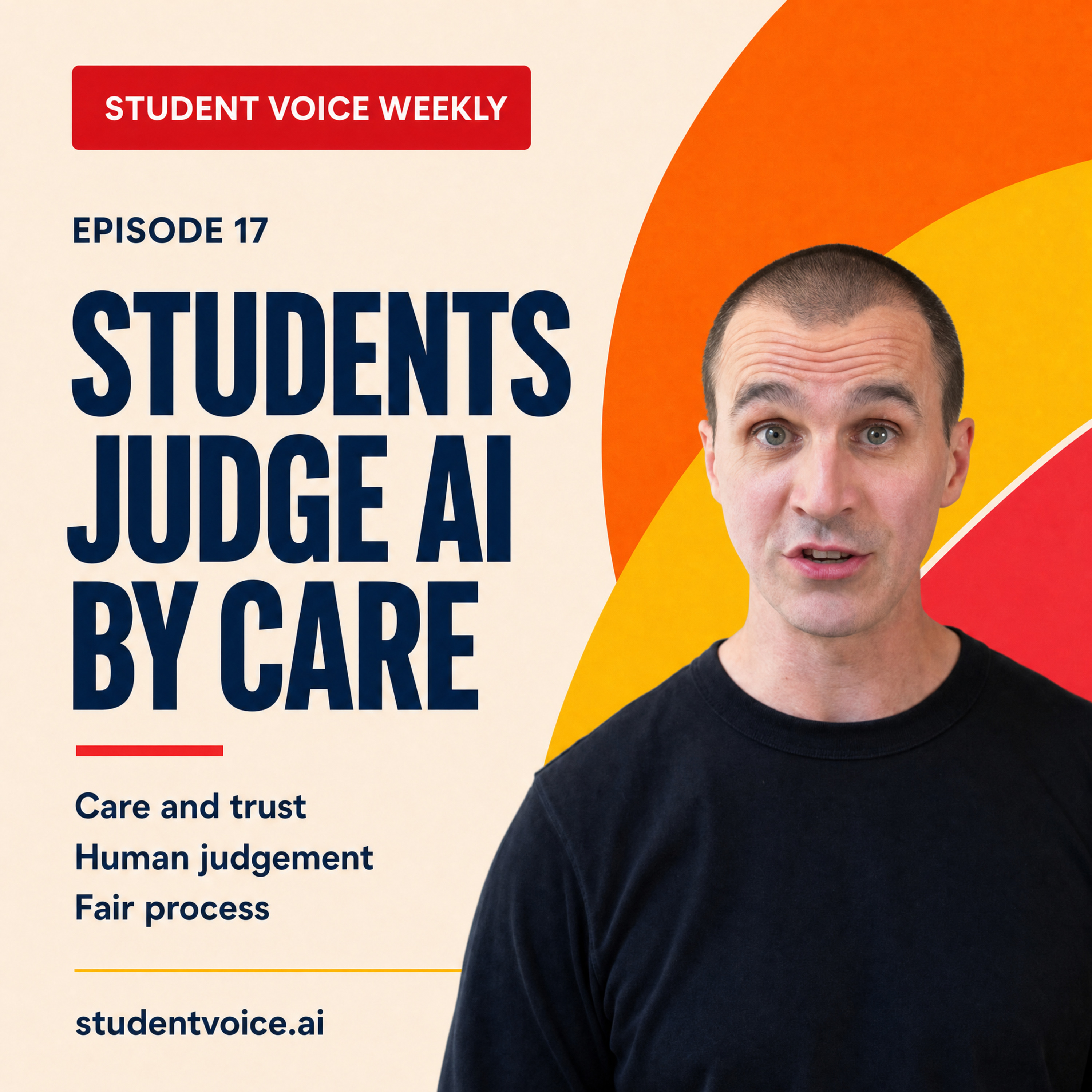
This week, Dr Stuart Grey discusses why students judge staff AI use through care, trust, fairness, and visible human judgement, not only through technical competence or speed.
The episode covers new research on student perceptions of AI-using teachers, evidence on AI detector false positives, Bath's survey architecture, QAA's assessment and feedback roadshow, and a practical way to separate student comments about care, clarity, fairness, and accountability.
In This Episode
- A brief Student Voice update on the build-up to NSS results day, new output formats, Newcastle University returning, and the University of Greenwich joining as a new customer.
- Why students can perceive teachers who use AI as less caring.
- Why visible human judgement matters when AI supports teaching, assessment, feedback, or academic integrity.
- What AI detector false positives mean for student trust and misconduct processes.
- How Bath's student feedback model shows the value of collecting evidence at the right level.
- Why QAA's assessment and feedback work reinforces the need to treat AI as part of assessment design, not a separate policy island.
- Why comments about AI should be separated by care, clarity, fairness, and accountability.
Student Voice Practice
AI comments should not be grouped under one broad theme. Some are about academic care, some are about unclear rules, some are about fairness in detection or marking, and some are about accountability when something goes wrong. The useful move is to code the action required, not just the presence of the word "AI".
Research Spotlight
- Students judge AI-using teachers by care, not just technical competence
- AI detectors catch many LLM-assisted essays, but privacy and false positives remain major risks
Across the Sector
- Bath's 2026 student feedback system shows how to collect the right survey at the right level
- QAA launches Assessment & Feedback Roadshow, what it means for student feedback on assessment
From the Archive
- Do history degrees build personal development?
- Does module choice shape history students' engagement and success?
- Do peer opportunities improve learning for literature students?
Practical Takeaway
When students comment on AI, separate the comments by the kind of trust problem they reveal: care, clarity, fairness, or accountability. Each one needs a different institutional response.
Full Episode Page
https://www.studentvoice.ai/podcast/episodes/017-students-judge-ai-by-care-not-just-competence/
Subscribe
Subscribe to The Student Voice Weekly: https://www.studentvoice.ai/blog/newsletter/
Transcript
Hi, and welcome to Student Voice Weekly. I'm Dr Stuart Grey, founder of Student Voice, and today's theme is AI and care: students judge staff use of AI by whether it still feels human, responsible, and fair.
Today I'd like to talk about a distinction that is going to matter more and more as universities bring AI into teaching, assessment, feedback, and student support. The question is not just whether the tool works. The question is whether students can still see the human judgement around it.
Before we get into the research, a quick Student Voice update. We're very busy in the build-up to NSS results day, putting the finishing touches to our new output formats and making sure they are useful when teams need to interpret results quickly. A big thank you to the customers who have given us such useful feedback as we've been developing them. And I'm really pleased to welcome Newcastle University back as a customer, and to welcome the University of Greenwich as a new customer. It's a nice moment, and it also connects to today's theme: the format of the analysis only matters if it helps people see what students are actually saying, and what needs to happen next.
That matters because a lot of institutional AI work starts with capability. Can it summarise comments. Can it draft feedback. Can it help with marking. Can it detect assisted writing. But students often experience the same change through a different lens. They ask, does my teacher still understand the subject. Are they still paying attention. Will someone take responsibility if the AI gets something wrong. And if I raise a concern, will I be treated fairly.
In the main story this week, the strongest signal comes from Bodong Yang's mixed-methods study of student perceptions of teachers using generative AI. The study randomly assigned 422 university students to evaluate teachers who fully used AI, collaborated with AI, or did not use AI. The important finding is that both AI-using teacher groups were perceived as significantly less caring than teachers who did not use AI.
That is worth sitting with for a moment. The issue was not only technical competence. It was care. In the follow-up interviews, students wanted to know that human judgement, responsibility, and intellectual leadership were still present. They were not simply objecting to AI existing. They were trying to work out whether the teacher had stepped back too far.
And this feels very real in the day-to-day world of university teaching. Students are usually quite pragmatic. They know staff are busy. They know digital tools are part of academic life. But when assessment, feedback, and support are involved, they want to know that a person is still taking the work seriously.
So the practical issue for universities is not, should staff ever use AI. That is too blunt. The practical issue is visibility. Can students see what the AI is doing. Can they see what the lecturer is still doing. Can they see where professional judgement enters the process. And can they see who is accountable.
If those things are hidden, even a useful AI process can feel like withdrawal. It can feel as though the university has found a faster way to do less. That may not be the intention at all, but student trust is shaped by what is visible.
The second research item this week is a useful warning about academic integrity. Guan and Han surveyed 156 STEM students and tested ChatGPT-4o as a detector across 156 essays. It identified 63 of 78 AI-assisted essays, but it also misclassified 53 of 78 human-written essays as AI-generated.
The key thing is that this is not just a technical performance problem. It is a student experience problem. A false positive is not an abstract error rate if you are the student sitting in a misconduct process. It is anxiety, time, reputation, and trust. It may affect how safe students feel asking questions about legitimate AI use. It may also affect how willing they are to use support that is allowed.
So if universities are using detector output, make sure the process is designed around human review, not automated suspicion. Detector output can be a prompt for a conversation or a check. It should not be carrying the decision on its own.
Across the sector, Bath's 2025/26 student feedback model gives a different but connected lesson. Bath separates NSS, a course-level survey, PTES, and PRES by cohort and purpose. NSS ran from February to April, the course-level survey ran in March, PTES ran from March to April, and PRES returns in spring 2027.
The useful lesson is survey architecture. Good feedback design is not just adding more channels. It is making sure each survey has a clear purpose, a clear level, and a clear route into action. Otherwise everything gets blurred. Course-level issues, module-level issues, postgraduate taught issues, postgraduate research issues, and national benchmark questions all get treated as if they are the same kind of evidence.
That matters for AI as well. If you ask students about AI in one broad survey question, you may get a lot of noise. Some comments will be about teaching practice. Some will be about assessment rules. Some will be about academic integrity. Some will be about feedback speed. Some will be about fairness. Some will be about whether students feel staff are still present.
The QAA Assessment and Feedback Roadshow is also worth watching here. The programme covered GenAI, assessment literacy, inclusive assessment, co-creation, marking, and feedback practice. For quality and student experience teams, that is a reminder that AI is not a separate island. It sits inside assessment design, clarity of briefs, marking confidence, inclusivity, and feedback literacy.
The mistake would be to send every AI comment to the AI policy group and leave it there. Some of those comments belong in assessment review. Some belong in staff development. Some belong in student communications. Some belong in programme-level conversations about what good feedback actually looks like.
So what does this mean for student comments, especially the free text in surveys, module evaluations, student voice meetings, complaints, appeals, and course reviews.
If I were looking at comments on staff use of AI, I would try and separate them into four strands.
The first strand is care. These are comments where students are asking whether staff still know them, still understand the subject, and still take their work seriously. They may not use the word care. They might say the feedback felt generic, the response felt automated, or nobody seemed to have read what they submitted.
The second strand is clarity. These are comments about rules, guidance, consistency, and expectations. Students might say one module says one thing and another module says something else. They might say the policy is too vague, or that they do not know what counts as acceptable support.
The third strand is fairness. These comments are about detection, accusations, appeals, marking, extensions, and whether different students are being treated consistently. This is where false positives and opaque processes can do real damage.
The fourth strand is accountability. These are comments about who decides, who checks, who explains, and who students can speak to when something feels wrong. This is where universities need to make human judgement visible.
That separation matters because the action is different for each strand. A care problem may need better staff-student dialogue. A clarity problem may need a single source of truth and better assessment briefs. A fairness problem may need process redesign and stronger human review. An accountability problem may need named routes for challenge and explanation.
The data is not the finish line here. Comments are where the real value is, because they show you how students are interpreting the system. They tell you whether the policy is landing as intended, whether the process feels human, and whether the university has accidentally created fear where it wanted to create support.
So the takeaway is this: when students comment on AI, separate the comments by the kind of trust problem they reveal. Care, clarity, fairness, and accountability are different problems, and they need different responses. That gives teams a clearer route from comments to action, rather than grouping everything under one broad AI heading.
That is it for this week. The full links and written summaries are in Student Voice Weekly. If you work with student feedback and want the research, regulation, and sector signals in one place each week, you can subscribe at studentvoice.ai. And if this was useful, please share it with someone working on student experience, assessment, or feedback, or leave a review in your podcast app. Thanks.