
The Student Voice Weekly / Episode 26
When academic challenge becomes avoidable stress
21 August 2026 · 5 min 38 sec
Dr Stuart Grey explores how universities can distinguish worthwhile academic challenge from avoidable stress created by course design.
Audio file: MP3 · 5.2 MB · direct download
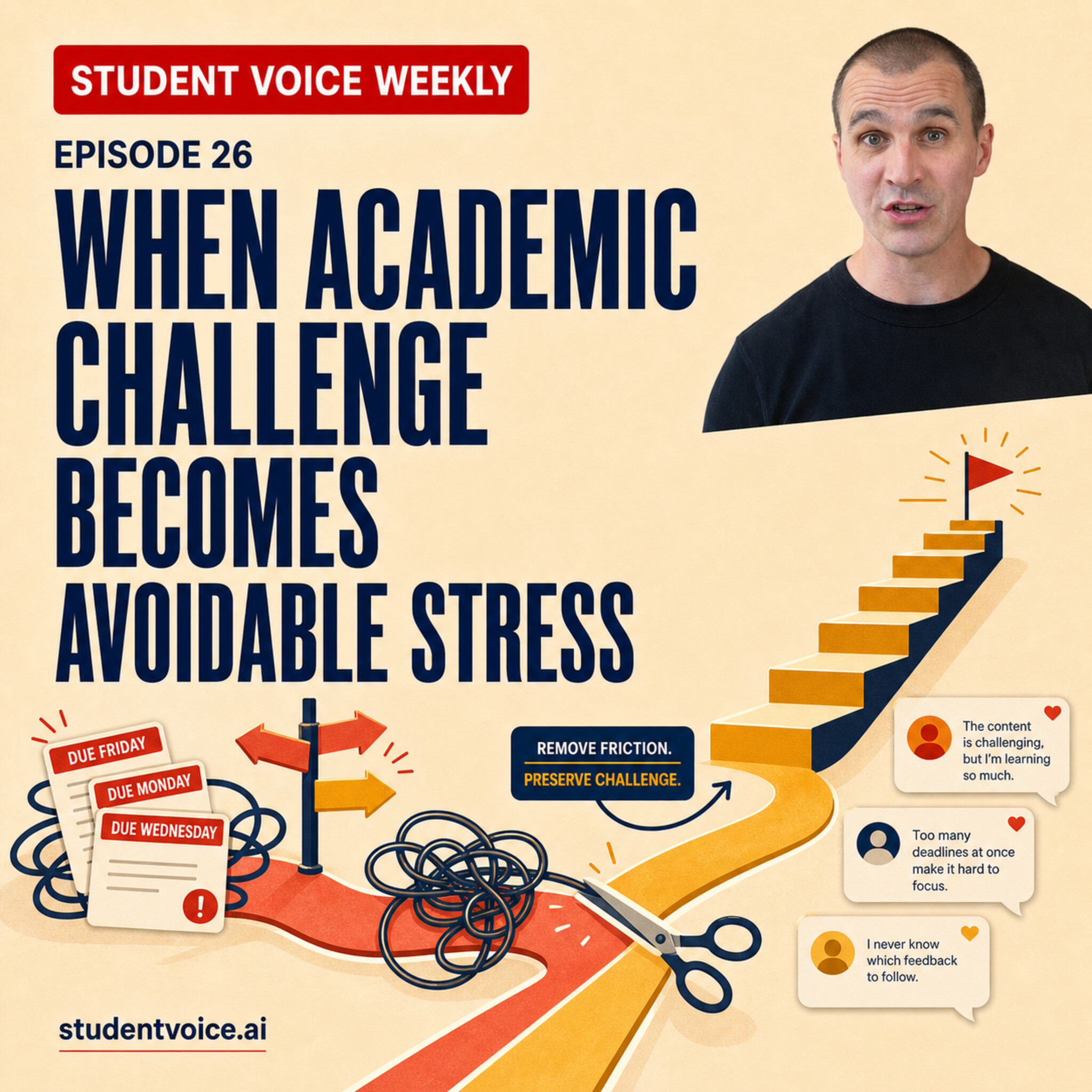
This week, Dr Stuart Grey asks where responsibility for academic stress actually sits.
Drawing on a national study of more than 19,000 undergraduates and research into how early-career academics use student evaluations, Stuart explores how universities can distinguish worthwhile academic challenge from avoidable pressure created by course design.
In This Episode
- Why academic stress cannot sit with counselling and wellbeing services alone.
- What a large Australian study suggests about the relationship between course experience and student distress.
- How workload bunching, unclear criteria and weak explanations of purpose create avoidable friction.
- Why evaluation scores show where to look while comments help explain what happened.
- How developmental conversations make student feedback more useful and safer for staff.
- Why repeated evidence and traceable comments matter when feedback concerns individual staff.
Research
- Academic stress is the strongest university-related distress signal
- Student evaluations become useful when comments explain the scores
Further Reading
Practical Takeaway
Choose one point in a programme where students report pressure and trace it back to the design decision behind it. Test whether the challenge is necessary, its purpose is clear, the workload is manageable, and the comments reveal avoidable friction that a course team can remove.
About This Recording
This episode was recorded by Dr Stuart Grey. The transcript was prepared from the final recording and lightly corrected for names, research terminology, and readability.
Subscribe
Subscribe to The Student Voice Weekly.
Transcript
Hi, and welcome to episode 26 of Student Voice Weekly. I'm Dr Stuart Grey, founder of Student Voice AI.
This week, I'd like to talk about academic stress.
So universities quite rightly invest in counselling, wellbeing services and specialist student support. But a paper I read this week made me think about the pressure that starts somewhere else: in the design of the course itself.
I do think that higher education should be challenging. Students are there to learn difficult things, develop new ways of thinking, and do work they may not initially feel confident doing.
But the question is whether the challenge is worthwhile, or whether students are spending all their energy dealing with avoidable friction around the learning itself.
The study involved more than nineteen thousand undergraduate students across sixteen Australian universities, so a great study. Around one in four students crossed the threshold for clinically relevant distress.
So the researchers looked at six aspects of university experience, including academic stress, belonging, peer engagement, teacher support, course value and the wider university climate.
Academic stress was by far the strongest university-related distress signal for these students. On its own, it accounted for roughly a third of the variation in distress, which was very close to the amount explained by all six university experiences altogether.
That does not mean academic stress caused every mental health difficulty in the study. The survey captured one point in time, and distress can also affect how somebody experiences their course, so the causality might be flipped.
But I think it gives course teams a really useful question: which parts of this pressure are designed into the student experience, and which of those could be changed?
So the answer might be assessment deadlines all bunching together. It might be the volume of assessed work, unclear marking criteria, unexplained timetable changes, or students doing a difficult task without the requisite scaffolding.
So those things are different from intellectual challenge.
A demanding assessment can be completely reasonable if the purpose is clear, students have had a chance to practise, and the workload across a programme is manageable. The same assessment can become avoidably stressful if instructions conflict, deadlines move, or every module assumes it has the only major submission that week.
So the practical issue is not to make courses easy. It is to make sure students spend their effort on learning, rather than trying to decode the system around the learning.
The study also found weaker experiences among students with disabilities and LGBTQ students. Again, I'd be careful about jumping straight from a group difference to an explanation. A demographic label does not tell you whether the issue is workload, access, peer connection, course value, or maybe several of those things at once.
That is where the comments themselves become important.
It's in the free-text comments that students actually tell you what is causing them stress. And reading a relatively small number of well-categorised and organised comments can really make a big difference to being able to improve our learning and teaching experiences for our students.
The second paper I read this week helps with that next step: how comments turn a general signal into something a teaching team can actually use.
So researchers combined more than five thousand student evaluations of forty-two teachers at a Dutch university with interviews involving sixteen early-career academics.
The evaluation included ratings and open questions. It was intended to support teacher development over time.
The average scores did not move very much across the whole group. But most of the academics interviewed said the open questions gave them new insights, and comments were often what they focused on when trying to understand the results.
This makes sense to me. If a score for feedback or teaching falls slightly, the lecturer still has to guess what happened. A comment might tell them that written feedback was detailed but arrived too late, explanations were clear but the pace was too fast, or that students valued the teaching but found it difficult to ask questions.
So the detail is really in those comments. Those are things you can have useful conversations about.
The paper also showed why the way universities use evaluation evidence matters.
Most of the academics said that they felt some tension around being evaluated. Some had constructive conversations with supervisors. Others said their results were barely discussed.
So the same survey can lead to reflection, defensiveness or no action at all, depending on what happens after the data arrives.
I think the useful model is to treat the score, the recurring comment themes and the staff conversation as one big evidence package.
The score shows where to look. The comments help explain what the students actually experienced. And the conversation afterwards allows staff to bring in the context and agree one or two changes worth testing.
That is much more useful than turning a small movement in an average into a judgement about somebody's teaching, for instance.
It is also safer for staff. Students must be able to say when teaching isn't working, but one hostile comment should not become the story of an entire module or an individual lecturer.
You've got to look for repeated evidence and keep the route back to the comments. So we want to make sure the purpose is development rather than high-stakes evaluation, and keep the stakes at a sensible level for what it actually is.
So the takeaway this week is this. We want to choose one point in a programme where students report pressure and trace it back to the design decision behind it.
Is the challenge necessary? Is the purpose clear? Is it avoidable? Is this some piece of friction that somebody could remove?
So that's it for this week. The papers, the QAA link and the written summaries are all in Student Voice Weekly. You can subscribe at studentvoice.ai if you'd like those in one place in your inbox each Friday.
And if this episode was useful, please share it with somebody working in teaching, quality, student experience or wellbeing.
Thanks.