
The Student Voice Weekly / Episode 19
Student feedback should start a dialogue
03 July 2026 · 6 min 50 sec
This week, the episode discusses NSS timing, VLE feedback, and dialogue. Why student feedback needs faster analysis, context, and academic judgement.
Audio file: MP3 · 6.3 MB · direct download
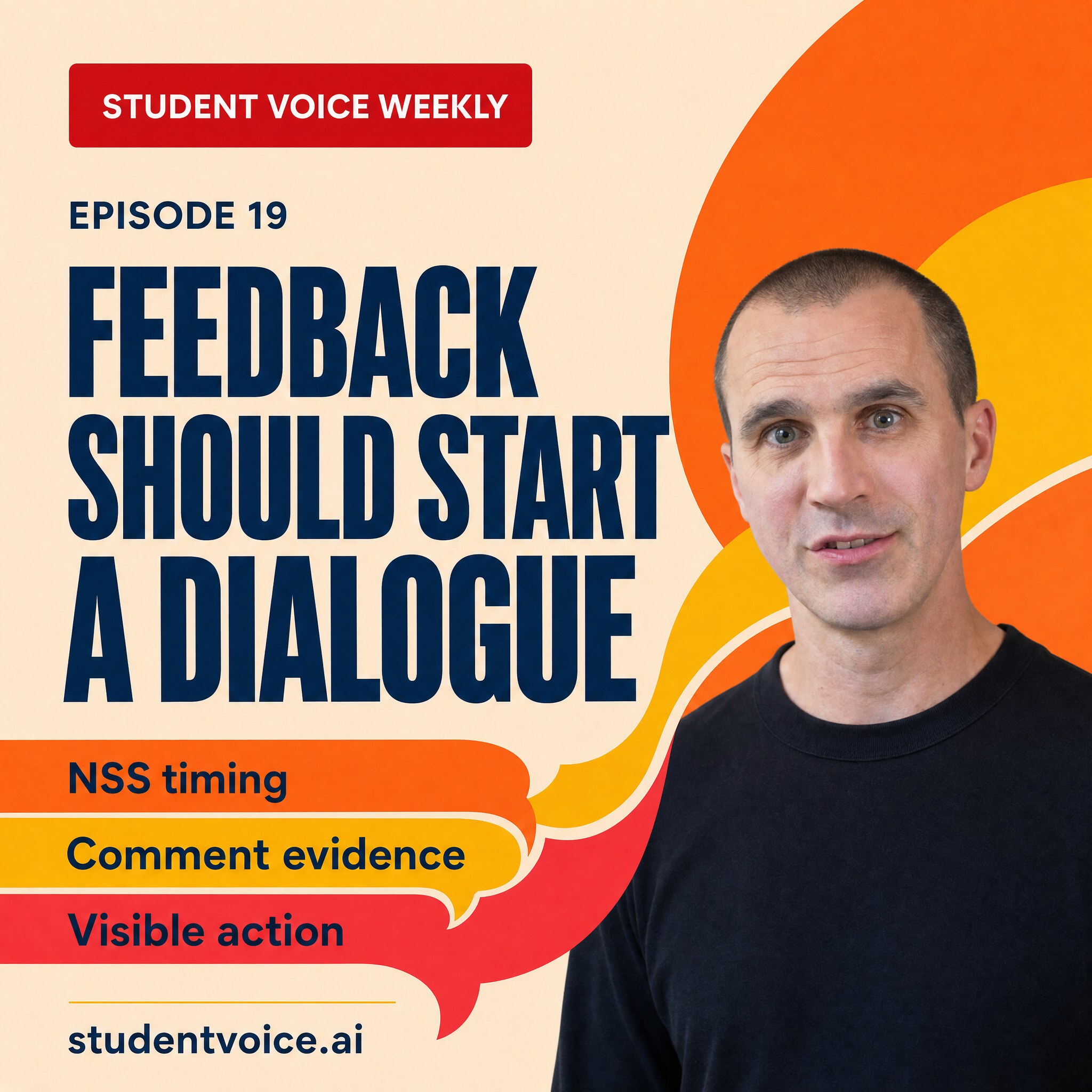
This week, Dr Stuart Grey starts with Daniel Robson and Helena Lim's Wonkhe piece on King's College London, where the NSS comment analysis work was delivered in collaboration with Student Voice AI.
The episode discusses why faster comment analysis matters only when it preserves enough detail for human review, academic judgement, and visible action while universities still have time to respond.
In This Episode
- What the King's College London example shows about turning NSS comments into usable evidence quickly.
- Why student feedback should not be treated as a direct verdict on teaching quality.
- Why NSS timing makes local, earlier feedback systems more important.
- How VLE feedback and reattempt loops change what universities should ask about digital learning.
- Why faster comment analysis matters only when it leads to earlier human review and visible action.
- How to separate comments about process, timing, interpretation, digital learning design, and trust.
Student Voice Practice
Feedback analysis should preserve enough context for dialogue. A useful approach distinguishes whether comments are about process, timing, interpretation, learning design, or trust, then routes the evidence to people who can act while action is still possible.
The King's example matters because it shows the practical value of keeping a traceable line between what students wrote, how comments were categorised, and the judgement course teams then make.
Research Spotlight
- Student evaluations should inform dialogue, not replace academic judgement
- VLEs scale better when feedback and reattempt are built in
Across the Sector
- Wonkhe's AI feedback analysis case shows how universities can act on NSS comments sooner
- Wonkhe's sector data warning shows why NSS and student feedback still arrive too late
From the Archive
- NSS open-text analysis methodology for UK HE
- The current understanding of student voice in assessment and feedback
- How to enhance student voice in university governance
Practical Takeaway
Treat student feedback as the beginning of a structured conversation. Keep enough detail in the comments to show what students meant, who needs to respond, and whether action can still happen in time.
Subscribe
Subscribe to The Student Voice Weekly: https://www.studentvoice.ai/blog/newsletter/
Transcript
Hi, and welcome to Student Voice Weekly. I'm Dr Stuart Grey, founder of Student Voice, and today's theme is student feedback as dialogue: how universities move from comments and scores into better conversations, better judgement, and visible action.
Today I'd like to start with Daniel Robson and Helena Lim's Wonkhe piece about King's College London. The King's work they describe was done in collaboration with us at Student Voice AI, so it is a good example of the thing I keep coming back to: student feedback only really helps when it reaches the right people while there is still time to talk about it and do something useful with it.
From the staff side, student feedback can sometimes arrive as a set of scores, a summary, or a list of comments long after the teaching has happened. From the student side, the important question is much simpler. Did anyone hear what we said, and did anything change while it still mattered to us.
That is why the King's example is a useful place to begin. The Wonkhe piece describes more than 1,700 NSS comments being analysed quickly enough to create over 5,000 category/comment combinations. That sounds quite technical, but the practical point is straightforward. The analysis was not just trying to produce a prettier dashboard. It was trying to preserve enough detail for course teams to see what students were actually saying.
So if students talked about feedback, were they talking about speed, usefulness, tone, consistency, or whether they knew how to use it. If they talked about organisation, were they describing timetable instability, unclear communication, assessment bunching, or the structure of the course. If they talked about support, were they talking about personal tutoring, academic confidence, wellbeing, or access to practical help.
Those are different conversations. If they all get pushed into one broad label, the action becomes weaker. You get a theme, but you lose the route into a sensible response.
That is also why the collaboration matters. The hard part is not simply getting a machine to put comments into boxes. The hard part is keeping a traceable line between the student's words, the category they have been placed in, and the judgement a human team then makes. Academic teams need to be able to look at the evidence, disagree with it, refine it, and ask whether it fits with what they know from teaching the course.
In other words, analysis should make the conversation better. It should not close the conversation down.
That distinction sounds small, but in practice it is the difference between giving a team evidence to work with and giving them another abstract metric.
The key thing is that faster analysis only matters if it gives people time to think. It creates a window before the new academic year has moved on, before course teams are fully into delivery again, and before the feedback becomes another historical document. That is the bit I think universities should pay attention to as NSS results day approaches.
Because NSS results day creates pressure. There will be new numbers, comments, comparisons, internal briefings, action planning templates, and plenty of nervous energy. Scores will go up. Scores will go down. People will want the headline quickly.
But the headline is rarely enough. A score can tell you that something needs attention. A comment can tell you what a student experienced. Neither one, by itself, tells you the whole story of teaching quality, curriculum design, academic standards, or what should happen next.
This is where the research in the newsletter helps. Maria Bengtsson's paper argues that student evaluations should inform dialogue, rather than replace academic judgement. I think that is exactly the right framing for the NSS period.
Students can tell you when communication has been poor. They can tell you when feedback came too late. They can tell you when assessment guidance felt vague, or when online materials helped them practise. That evidence is valuable.
But teaching also has purposes that students may not see from one module encounter. A difficult task may be difficult for a good reason. A curriculum decision may make sense across a programme even if it is frustrating in week five. And sometimes a comment is pointing to a real problem, but the right response is not obvious until staff and students talk about it together.
So the useful question is not simply, what did the score say. The useful question is, what conversation should this evidence start.
That connects to a second Wonkhe article in the newsletter, about whether sector data still arrives quickly enough to support improvement. The argument there is that higher education often relies on evidence that is slow. NSS is important, but it is a final-year survey, and by the time results are public the students who raised the concerns have usually moved on. Graduate outcomes arrive later still. Annual sector data is useful for accountability, but it can be too slow for the kind of improvement students notice directly.
That does not make NSS unimportant. It means NSS cannot carry the whole feedback system.
Universities need local evidence that arrives earlier: module comments, course-level pulse surveys, rep intelligence, learner analytics, service feedback, and the small signals that tell you something is going wrong before it becomes a public metric.
But local evidence only helps if it is governed properly. Who reviews it. How often. What counts as a pattern rather than noise. Which comments are escalated. How do teams check whether the same concern appears in more than one place. And how does that local evidence connect back to NSS and TEF narratives later on.
Michael Mcguire's paper on virtual learning environments adds another useful angle. Mcguire looks across 21 UK institutions and shows that VLEs worked better when short tasks, clear criteria, automated feedback, and repeat attempts were designed together.
What I like about that paper is that it pushes against a tempting shortcut. It says, do not confuse activity data with learning.
A login tells you that a student accessed something. Time on a page tells you that a page was open. But those signals do not tell you whether the student could practise, whether the feedback made sense, whether they had time to try again, or whether the activity fitted into the rhythm of the module.
So if a university is asking students about digital learning, the question cannot just be, did you use the VLE. It has to get closer to the learning design. Could you practise the thing you were being asked to learn. Did you get feedback quickly enough to use it. Could you have another attempt. Was the work inside the timetable, or was it pushed into optional time that only some students really had.
Again, the data is not the finish line. The data helps you work out what to ask next.
So the takeaway is this: lead with the comments, but do not stop at categorising them. Make sure the comments are grouped with enough detail that people can see the real problem. Make sure the evidence gets to the people who can act while action is still possible. And make sure the response is visible enough that students know their feedback did not just disappear into a system.
That is it for this week. The full set of links and summaries is in Student Voice Weekly. If you work with student feedback and want the research, regulation, and sector signals in one place each week, you can subscribe at studentvoice.ai. And if this was useful, please share it with someone who works on student experience, teaching, quality, or planning, or leave a review in your podcast app.