
The Student Voice Weekly / Episode 21
What QAA wants universities to do after NSS
17 July 2026 · 7 min 44 sec
This week, the episode discusses representation, accent bias, and short-course feedback. Why student representation needs training, trust, and broader evidence.
Audio file: MP3 · 7.1 MB · direct download
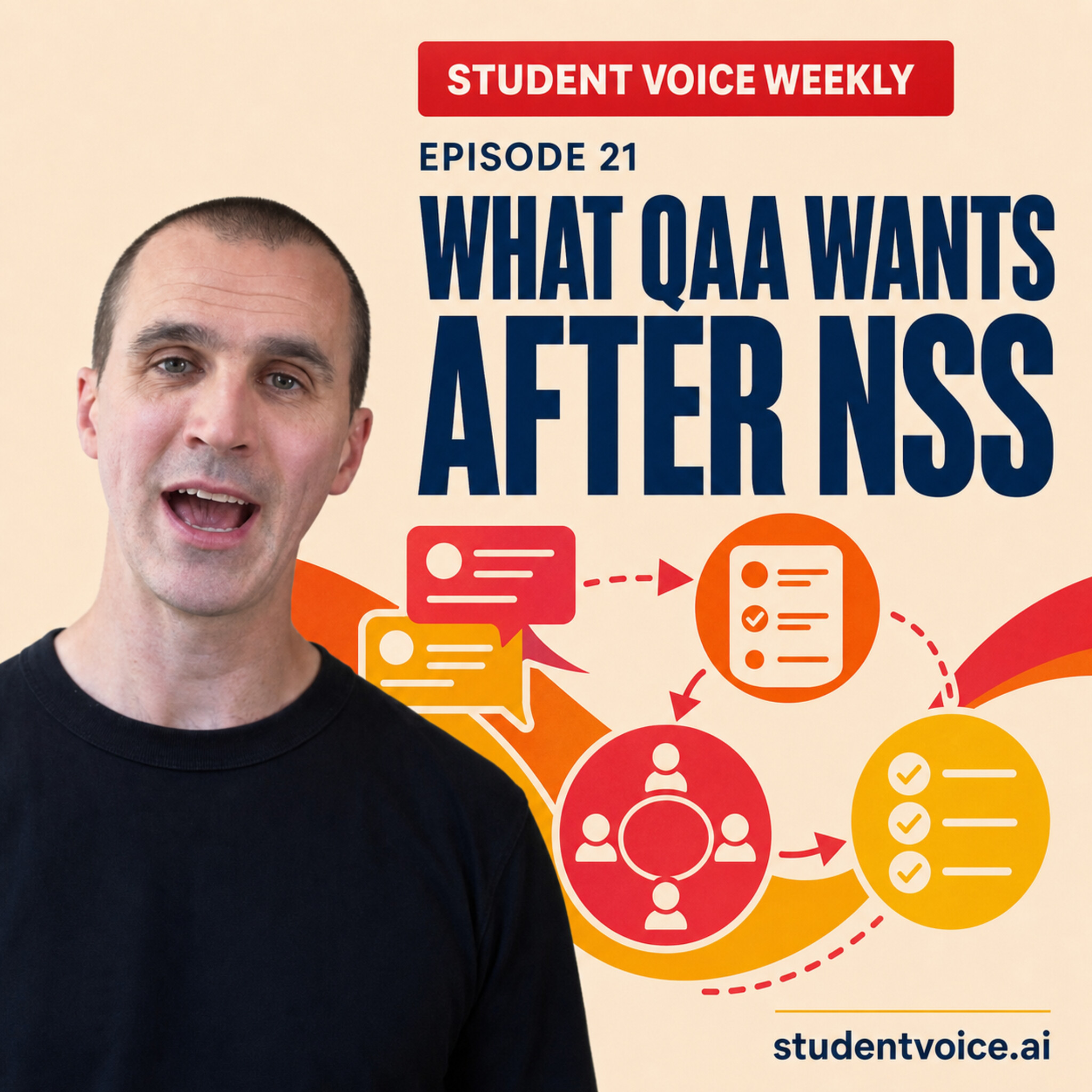
This week, Dr Stuart Grey focuses on QAA's response to NSS 2026 and what universities need to do once the results-day headlines have passed.
The episode looks at internal enhancement, weaker experiences among part-time, apprenticeship, and disabled students, the cost of taking part in student engagement, and the support student representatives need to contribute meaningfully to quality assurance. It also considers why shorter provision needs faster feedback loops.
In This Episode
- Why improving NSS averages should not close down the conversation about subgroup gaps.
- What QAA's post-results message means for internal enhancement work.
- How time, money, accessibility, and recognition shape who can participate in student voice.
- Why student representatives need clear papers, briefings, mentoring, and wider survey evidence.
- How short-cycle provision changes the timing of student feedback.
Student Voice Practice
Use NSS as the beginning of an internal quality conversation. Bring scores, subgroup patterns, and open comments together, then connect that evidence to supported student representatives and named institutional owners.
When analysing comments, distinguish the student experience itself from barriers to participation and evidence about follow-through. These patterns require different actions and often belong to different teams.
Research Spotlight
Across the Sector
- QAA says NSS 2026 should drive internal student voice action, not just league tables
- QAA's short-cycle course guidance says student feedback must move faster for the LLE
Practical Takeaway
Bring NSS scores and comments together, check who is missing or having a weaker experience, support representatives to interpret the evidence, and record who owns the response and when students will see what changed.
Subscribe
Subscribe to The Student Voice Weekly.
Transcript
Hi, and welcome to Student Voice Weekly. I'm Dr Stuart Grey, founder of Student Voice, and today's theme is what universities do after NSS results day, when the headlines have settled and the quality work really begins.
Today I'd like to talk about QAA's response to NSS 2026. NSS is still very much top of mind across the sector, and rightly so. Last week I talked about the results themselves, the stronger national picture, the gaps in disabled students' experience, and the work involved in turning thousands of comments into usable evidence.
This week, the question is what happens next.
QAA published its account of a post-results discussion at QAA Connect, and the strongest message was that NSS should be used internally. League tables and public comparisons will always get attention. But for universities, the real value sits in using the scores and comments to understand where the experience is weaker, which students are affected, and what can actually change.
That sounds obvious, but it is quite a demanding standard. A university can publish a positive headline, send subject-level dashboards around, and ask every school for an action plan. None of those things guarantees that the institution has understood what students are actually saying.
QAA pointed to weaker experiences among part-time and apprenticeship students, particularly around academic support and student voice. The Office for Students data also showed weaker results for disabled students across every theme in England. So the key thing is to avoid letting an improving average close down the conversation.
If the overall student voice score has risen, that is good news. But if part-time students, apprentices, or disabled students are still reporting a weaker experience, the institutional question becomes much more specific. Is the problem how support is organised? Is it when meetings happen? Is it the time and cost involved in participating? Is it communication, assessment, timetabling, or a lack of visible follow-through?
QAA also raised something that is easy to overlook in student engagement work: participation has a cost. Students are asked to attend committees, join panels, complete surveys, and contribute to enhancement projects. That requires time, confidence, and sometimes travel. In a cost-of-living crisis, the students who can afford to take part may not be representative of the students whose experience most needs to be understood.
Paying students can help, but even that needs care. QAA noted that payments may affect some students' carer or disability-related benefits. Recognition, flexibility, timing, and practical support all matter. The design of participation shapes the evidence an institution receives.
One thing you notice when you are close to teaching is just how different students' available time can be. Some can stay after class, attend a meeting, or take on a representative role. Others are leaving for paid work, travelling a long way home, managing caring responsibilities, or dealing with health issues. If the main route into student voice assumes spare time, it will consistently hear some students more clearly than others.
That connects very neatly to the main research paper in the newsletter. Hiroko Take and Åsa Kettis interviewed 20 student representatives, 10 teachers, and 8 administrators across three Swedish universities. They looked at what students need in order to participate meaningfully in quality assurance.
Their answer was not simply confidence. Effective representatives need enough context to read papers, prepare for meetings, express a view, and speak beyond their own individual experience. The useful part is that these capabilities develop through participation. Students learn by doing the work, with briefings, mentoring, handbooks, pre-meetings, and support from staff and student unions.
So universities should not recruit a student representative and assume the job is finished. Make sure the agenda is clear. Send papers in a usable form. Offer a short conversation before the meeting. Explain the language and the decision being made. Give the student permission to question the framing, not just comment on a proposal that is already complete.
The research also shows why course evaluations and NSS evidence matter to representatives. A rep will always bring personal experience into the room, and that is valuable. Broader survey and comment evidence helps them test whether the issue is isolated, shared across a cohort, or concentrated among a particular group.
Low response rates therefore create a quality problem. If the survey evidence is thin and only a small number of students can attend formal meetings, the process becomes dependent on whoever happens to be present. That is a fragile basis for claims about the student experience.
The practical connection to QAA's NSS message is quite strong. Internal enhancement needs more than a dashboard, and representative participation needs more than a seat at the table. Universities have to connect the different parts of the evidence system: the national survey, local feedback, open comments, student representatives, staff interpretation, and a visible record of what happened next.
There is a second QAA development worth watching. QAA has published a new Characteristics Statement for short-cycle courses and an HTQ-readiness toolkit as the Lifelong Learning Entitlement approaches. These courses are shorter and often more flexible, with a strong professional, vocational, or technical focus.
For student voice, the practical consequence is speed. A learner can move from induction to assessment and exit before a conventional end-of-course survey has been analysed. Feedback gathered after the learner has moved on may still help the next cohort, but it cannot fix unclear joining instructions, a problem with digital access, or confusing assessment guidance for the students experiencing it now.
Short-cycle provision needs focused listening points during the journey. Ask about onboarding while there is still time to improve onboarding. Ask about assessment guidance before the assessment is complete. Make sure someone owns the response and can act quickly. The data is not the finish line, especially when the course itself may only last a few weeks or months.
If I were looking at student comments across these issues, I would want to separate three things.
First, comments about the experience itself: academic support, assessment, communication, timetabling, access, or course organisation. Second, comments about the feedback route: whether students knew how to raise an issue, could afford the time to participate, and felt safe doing so. Third, comments about follow-through: whether anyone responded and whether students could see that their input changed anything.
Those categories require different action. A support problem may belong with a course or service team. A participation barrier may require changes to meeting times, payment, access, or representation. A follow-through problem may sit with governance and communication. Grouping all of them under a broad heading such as student voice makes it harder to see who should do what.
So the practical takeaway is this: use NSS as the start of an internal quality conversation. Bring the scores and comments together. Check which students are missing or having a weaker experience. Give representatives the evidence and support they need to contribute. Then record who owns the response and when students will see what changed.
That is what turns NSS from an annual publication into a student voice system people can trust.
That is it for this week. The full links and written summaries are in Student Voice Weekly. If you work with student feedback and want the research, regulation, and sector signals in one place each week, you can subscribe at studentvoice.ai. And if this was useful, please share it with someone working on quality or student experience, or leave a review in your podcast app.