
The Student Voice Weekly / Episode 13
AI Feedback Needs Teacher Judgement and Better Design
22 May 2026 · 8 min 37 sec
This week, the episode discusses AI feedback, assessment evidence, and student value. Students welcome AI feedback when teacher judgement stays in the loop.
Audio file: MP3 · 7.9 MB · direct download
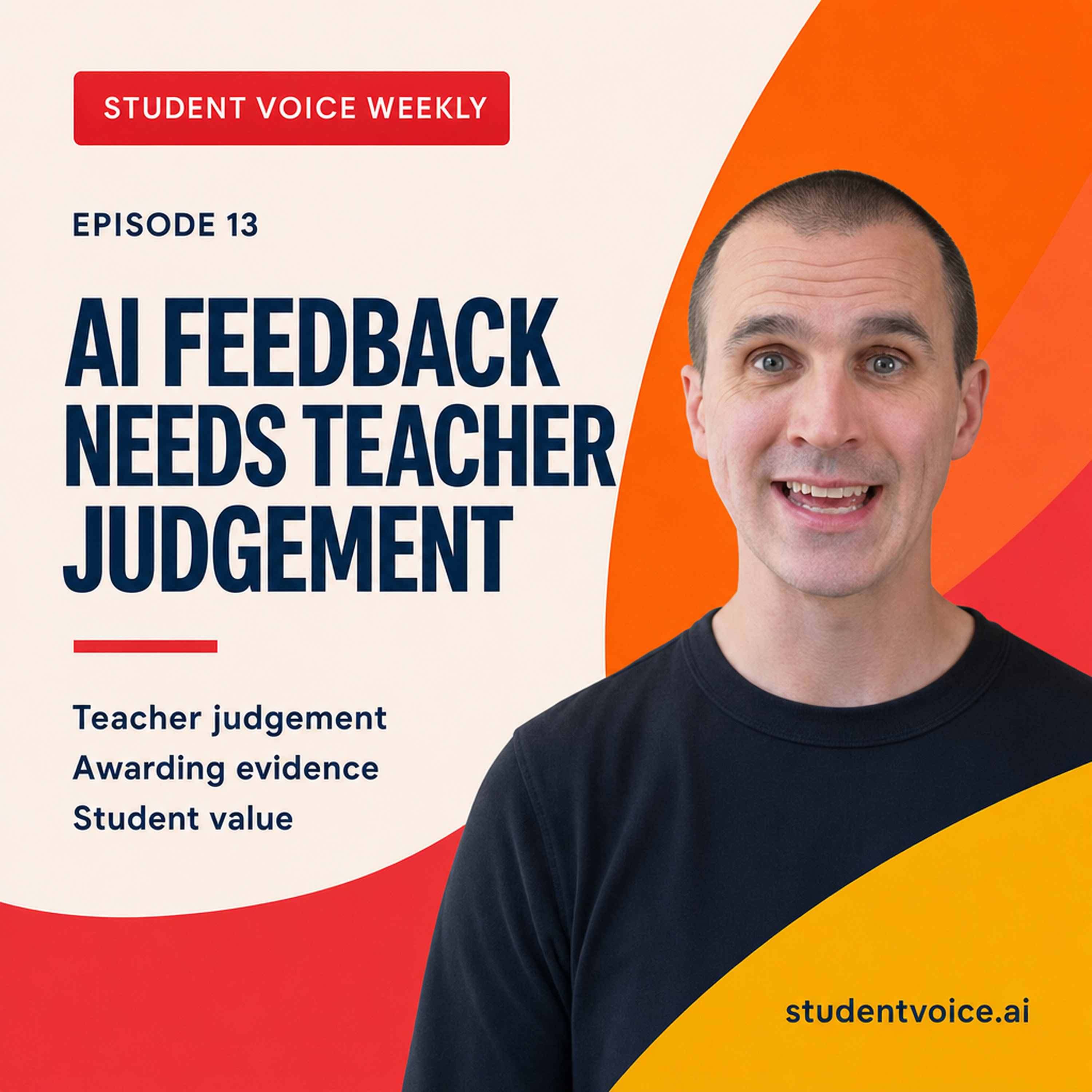
Audio briefing based on Student Voice Weekly issue #13.
This week, Dr Stuart Grey discusses AI feedback and student voice evidence: how universities can use AI feedback without removing teacher judgement, and how assessment evidence connects with student value, belonging and attendance.
The episode covers AI feedback design, paid student voice roles, QAA Scotland's review of awarding evidence, HEPI's latest findings on student value and belonging, and practical ways to test whether feedback is specific, trusted and usable.
In This Episode
- Why students tend to value AI feedback most when teacher judgement stays visible.
- How paid student voice roles can make representation more accountable when the route from input to action is clear.
- What QAA Scotland's national review of awarding arrangements means for student voice evidence around assessment.
- Why student value, belonging and attendance need local comment analysis rather than headline numbers alone.
- A practical way to review AI feedback pilots before scaling them.
Student Voice Practice
Student voice work is most useful when it turns a general sector discussion into an institutional question that teams can test locally. For AI feedback, that means asking students whether the feedback was specific, whether they trusted it, and whether they could use it in their next piece of work.
Research Spotlight
- Students value AI feedback most when teacher judgement stays in the loop
- Paid student voice roles can make representation more accountable
Across the Sector
- QAA national review: awarding arrangements and student voice evidence
- Student Academic Experience Survey: student value, belonging and attendance
From the Archive
- Computer science students' views on Covid-19 challenges
- Navigating university life: insights from education students
- English literature students' perspectives on Covid-19
Practical Takeaway
Before scaling an AI feedback pilot, ask students three direct questions: was it specific, did they trust it, and could they use it in the next piece of work? Then compare those answers with teacher judgement rather than treating the tool output as the answer.
Full Episode Page
https://www.studentvoice.ai/podcast/episodes/013-ai-feedback-needs-teacher-judgement-and-better-design/
Subscribe
Subscribe to The Student Voice Weekly: https://www.studentvoice.ai/blog/newsletter/
Transcript
Hi, and welcome to Student Voice Weekly. I’m Dr Stuart Grey, founder of Student Voice. Today I’d like to talk about AI feedback and trust, and why the human bit still matters if you want it to work for students.
A lot of universities are piloting AI-generated feedback right now. Sometimes it is small-scale. Sometimes it is moving quickly into core practice. The key question underneath it is simple.
Is the AI being designed around learning, or is it mainly being used to move comments through the system faster.
Students can tell the difference. A poorly designed pilot gives students a new reason to distrust assessment, which then feeds complaints, appeals, and disengagement.
And to ground this, I still teach part-time at the University of Glasgow so I understand the pressures and the nuance around this subject, and when I talk about feedback, I mean the actual moment a student opens the comments, tries to interpret them, and decides whether it is worth putting effort into the next piece of work.
In the main story this week, the strongest research signal is a systematic review by Ozturk and Cebi on students’ perspectives of AI-generated feedback in online learning.
The most useful headline is that students want a blend.
Some students prefer teacher feedback. Some find AI feedback helpful. A lot want both. What keeps coming up is the combination: speed, context, specificity, and judgement.
That matters because some institutions are framing AI feedback as a turnaround-time fix. And yes, late feedback is one of the most consistent themes in student comments.
But make sure you separate fast feedback from good feedback.
If feedback arrives quickly but feels generic, does not reference the brief, or does not match what was taught, students interpret that as being fobbed off. The concern often deepens from “unhelpful feedback” into “they didn’t read my work”. AI can increase that risk unless you design around it.
So here is the practical position I think most universities should land on.
AI feedback can be a useful first layer, especially for formative work. It can help students get momentum, improve structure and clarity, and spot gaps against criteria.
But the moment feedback is tied to grades, progression, professional accreditation, or anything high-stakes, students want clear human accountability. They want to know an academic is responsible for the judgement, and that there is a way to query it.
That is students being rational about fairness, especially when feedback connects to grades, progression, or professional standards.
So what does this mean for universities, practically.
First, if you are running pilots, do not evaluate them using a single satisfaction question like “did you like the AI feedback”. That is too blunt. Test for the things students actually talk about.
One is specificity. Does it point to their work and the criteria, with more precision than generic study advice.
Two is trust. Do students believe it is accurate and aligned with the module, the discipline, and what staff actually value.
Three is usability. Can they act on it next time, or is it just fluent text.
Second, design the teacher in the loop, and make it visible.
That can mean staff designing the prompt and rubric carefully so the AI is anchored to the brief. It can mean staff reviewing and signing off feedback before release. Or it can mean adding a short human layer that says, “here is what matters most for the next submission, here is where you should focus”.
The key thing is this. If academic judgement is hidden, students assume it is absent.
Third, connect AI feedback to your assessment governance. If AI is involved anywhere in the process, you need a clear decision trail. Who set the criteria, who approved the approach, who checked the output, and how students can ask questions. That is what protects trust.
There is another piece of research worth using this week: a case study from Warwick History on paid Student Voice Ambassador roles.
The basic argument is that paying students, setting clearer expectations, and treating it more like a defined role can make student representation more consistent and more legitimate.
I think that is broadly right, with one caution.
If you pay students for student voice work, make sure you are paying for a job, not paying for agreement.
Pay for the labour: gathering evidence, synthesising themes, feeding back to students, and helping staff run better conversations. Do not pay for “being the student voice” as if one student can speak for everyone.
And make sure any Ambassador model sits alongside elected reps. Quietly replacing elected representation creates a credibility problem that usually shows up later when something contentious lands, like assessment changes.
The design point is the key thing here. Do not recruit students into roles until you have designed the route from input to action. If staff are not ready to respond, you will burn trust quickly.
Across the sector, there is also an awarding arrangements story to watch. QAA Scotland has published the institutional guide for Phase 3 of the National Review of Awarding Arrangements.
Two practical signals matter.
One is that deep-dive reviews include meetings with students and with Students’ Associations or Unions. The other is that there is a student reviewer on the peer team.
So the bar is rising in a very concrete way.
Institutions need to show how assessment and awarding concerns travel through the system, and what decisions were made. A general claim that “we listen to students” will not carry much weight unless there is an evidence trail behind it.
The risk is that many universities have the parts, but they are scattered. Module evaluation comments sit in one place. Rep notes sit in another. Complaints data sits somewhere else. Assessment board minutes are separate again. When reviewers ask “how did you know” and “what did you do”, the institution cannot produce a clean chain from signal to action.
Alongside that, HEPI’s 20-year analysis of the Student Academic Experience Survey is another useful sector signal. The familiar drivers are there, like teaching quality, belonging, and feedback. But one thing that stands out is the long-term attendance trend.
The share of students attending all scheduled classes has dropped a lot over that period.
I would be careful about treating that as a simple motivation problem. Attendance reflects whether sessions feel worth it, whether the design works, whether students are commuting or working, and whether they feel behind or disconnected.
So if your attendance data is shifting, treat it as a diagnostic prompt, then go straight to what students are actually saying in the comments.
When you come back to student comments, this is where the detail matters. If you are reading comments this week with these themes in mind, here are a few useful separations to make.
First, with AI feedback, separate speed from quality. Students will often say “it was quick” and “it did not help” in the same breath. That usually points to a system optimising the wrong thing.
Second, separate clarity from fairness. A student can understand feedback and still think the mark is unfair. Or they can accept the mark but feel the feedback is too vague to act on. Those require different fixes.
Third, look for signals about teacher presence. Students rarely use the phrase “teacher judgement”. They say “it felt automated”, “nobody read it”, or “I could not ask follow-up questions”.
If you want AI feedback to land well, wrap it in a human process. A structured opportunity to query, a short follow-up tutorial, or a quick run-through of common issues and what good looks like.
And on awarding and assessment, watch for comments that point to process failure: inconsistent advice, shifting criteria, or unclear decisions. Those are the comments that turn into formal problems if you ignore them.
One practical thing to try this week is this. In your next learning and teaching, quality, or assessment meeting, pick one module where you have both quantitative scores and free-text comments about assessment and feedback.
Do a simple two-column sort.
In column one, put comments asking for better information: clarity of criteria, examples, what good looks like, what this feedback means.
In column two, put comments asking for better judgement and engagement: “this doesn’t reflect my work”, “it feels generic”, “it doesn’t match what we were taught”, “I need a conversation”.
Then ask one question.
Which of these problems would AI plausibly help with, and which would AI plausibly make worse.
That one question shifts the conversation from “should we use AI” to “where does AI fit in the feedback system, and what human parts must stay visible”.
So the takeaway is this: if you are using AI for feedback, make the human judgement visible. Keep the decision trail clear, and use student comments to test whether feedback feels specific, fair, and usable.
The links are in the show notes, and you can get the written Student Voice Weekly newsletter at studentvoice.ai.
If this was useful, please follow the podcast, leave a quick review, or send it to a colleague.
Thanks for listening, and I’ll speak to you next week.
Suggested short title
AI feedback needs teacher judgement
Suggested social post
AI feedback is moving from pilots to mainstream practice across UK universities.
Students have mixed and practical expectations of AI feedback. They value speed and availability, but they still want context, specificity, and visible teacher judgement, especially when feedback links to grades and progression.
If you are piloting AI feedback, test whether students find it specific, trustworthy, and usable, and whether human accountability is clear.
Suggested newsletter cross-link
This week’s issue pulls together three connected threads: students’ expectations of AI feedback, how departments can design more accountable paid student voice roles, and why QAA Scotland’s awarding review raises the bar for evidence trails. If your feedback and assessment systems are scattered, you will feel that pressure first in student comments, and then in formal process.
Source material
- The Student Voice Weekly, Issue 13 (22 May 2026)
- Research spotlight: Ozturk and Cebi systematic review on student perspectives of AI-generated feedback in online learning
- Research spotlight: Warwick History case study on paid Student Voice Ambassador roles
- Sector news: QAA Scotland Phase 3 institutional guide for National Review of Awarding Arrangements (student meetings, student reviewer)
- Sector news: HEPI 20-year Student Academic Experience Survey analysis (teaching quality, belonging, feedback, attendance trends)